
Interview: Paul Hamblyn, international athlete and coach at North Harbour Bays Athletic Club
Coach Feedback: Rekortan Gel in Auckland, New Zealand
Ex-NZ athlete Paul Hamblyn discusses this coaching career and experiences on the new Rekortan Gel track at AUT Millenium in Auckland, New Zealand.
Tell us about your role as a athlete and coach?
I have been involved in the sport all my life. I was primarily a 1500m runner came fourth at the 2006 Commonwealth Games in Melbourne. Now I manage and coach through a charitable organisation called North Sport Academy. My role involves both managing the programme and coaching athletes for the Bays Athletic club in Auckland.
I’m based at AUT Millennium in Auckland. It’s a high-performance facility linked with AUT University, and we have a new Rekortan Gel which was installed in November, 2024.
North Harbour Bays Athletics Club, Auckland
It has only been a year and a half, but what are your observations about the track?
The difference from our old track has been immense. The previous track had been there for over 10 years, so it was pretty hard. The Gel track’s softness and the bounce is very noticeable.
What type of athletes do you coach?
I coach a wide range, from 800 metres through to the marathon. We have 14-year-olds to international athletes, to masters athletes, so it’s a very broad mix in terms of age, ability, and training demands.
With such a wide range, what kinds of injuries do you see most often?
The biggest issue by far is Achilles problems. That’s the most common injury across the group. With older athletes, we also see an increase in calf injuries, which is typical because calf strength and tissue integrity naturally decline with age.
With the new track, have you seen any reduction in calf and Achilles problems?
We haven’t been on the track for long - but yes I think so.
We do a lot of work on the road during the winter and for marathon training, where athletes tend to be more midfoot or heel striking. When they come back onto the track and start running on their toes again, especially in spikes, there’s always a bit of an adjustment and I normally see calf issues.
Back when I was running, it could take a month to adjust. But on the Gel track, because the track softer and gives more energy return, I don’t think the transition has been quite as significant.
Three young athletes who previously had shin pain over winter have been able to complete their summer track training without needing time off. In the past, track sessions would aggravate those issues and require us to reduce their time on the track.
Any impact in terms of athlete recovery or fatigue?
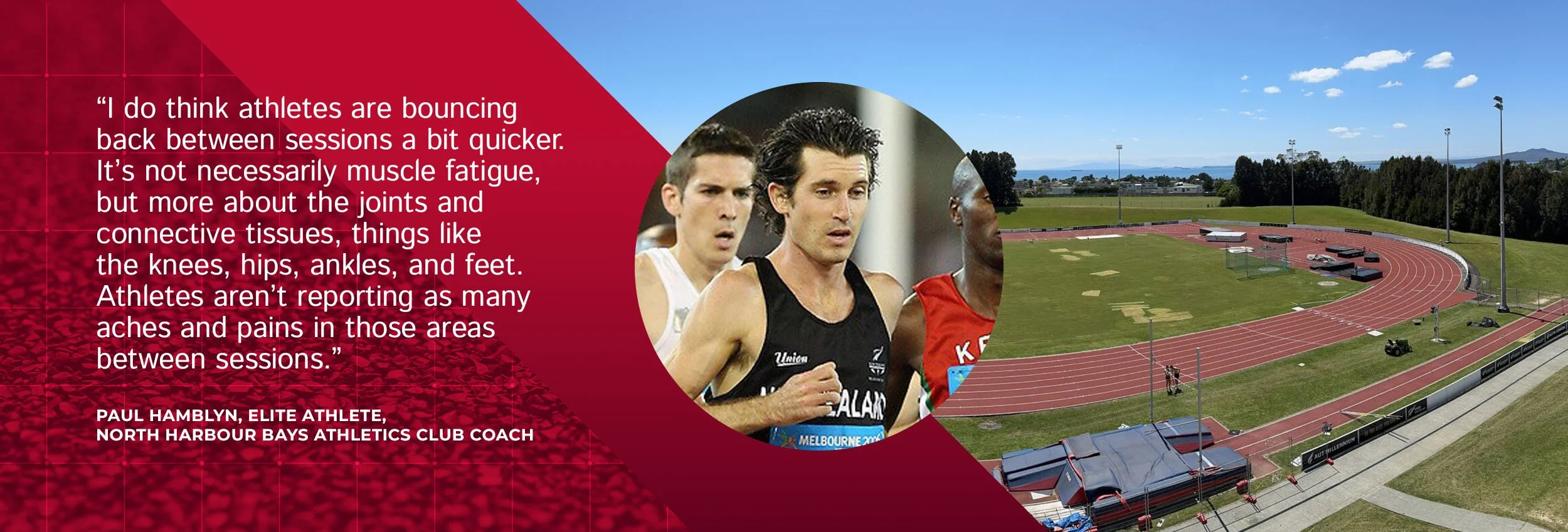
Yes, I do think athletes are bouncing back between sessions a bit quicker. It’s not necessarily muscle fatigue, but more about the joints and connective tissues, things like the knees, hips, ankles, and feet. Athletes aren’t reporting as many aches and pains in those areas between sessions.
North Harbour Bays Athletics Club, Auckland
What is the performance benefit of this reduction in aches and pains?
The main benefit is higher-quality training sessions. If athletes recover better, they’re able to perform better in their next workout and potentially handle a bit more training.
And, if this continues, it will have a big impact because consistency is the most important factor for improving performance over time.
If athletes frequently have interruptions, like needing extra recovery weeks, lighter training blocks, or time off due to soreness or injury, their progress slows down. Better recovery helps maintain consistent training over long periods, which ultimately supports better performance development.
“Three young athletes who previously had shin pain over winter have been able to complete their summer track training without needing time off. In the past, track sessions would aggravate those issues and require us to reduce their time on the track.”
How do you typically manage track time for different types of runners?
It generally depends on the event. Middle-distance runners and sprinters tend to spend more time on the track and train at higher intensities. Distance runners, on the other hand, usually focus more on volume with lower intensity, so they spend less time on the track.
What about footwear, do your athletes always train in spikes?
Not necessarily. Even with middle-distance runners, I try not to have them do everything in spikes. They’ll still do a lot of their work on the track, but often in trainers or road shoes. That provides a bit more comfort and protection for their legs.
Could the performance of the Gel track change that approach?
Potentially, yes. If the track surface is safer and more forgiving, you might feel more comfortable allowing athletes to train in spikes a bit more often.
Has there been any competitive performance impacts?
Our track is mainly a training track, but I do run a big event called the Night of 5s in December, and we had a lot of personal bests, from 800 metres right through to 5,000 metres. The fields are strong and we do have pacemakers, but for sure the personal bests are a good sign that the track is fast.
And all of our juniors have run personal bests this year. Of course, performance improvements are multifaceted - motivation, development, and training all play a role.
Did you have concerns about the softer surface affecting speed?
I was concerned that while a softer track might be better for athletes’ joints, it could potentially slow things down. But the results suggest that hasn’t been the case and some athletes have mentioned that once you understand how to apply force into the track, it really gives you a return.