
Q&A: Marybeth Price on Pressure, Potential, and Penn Relays
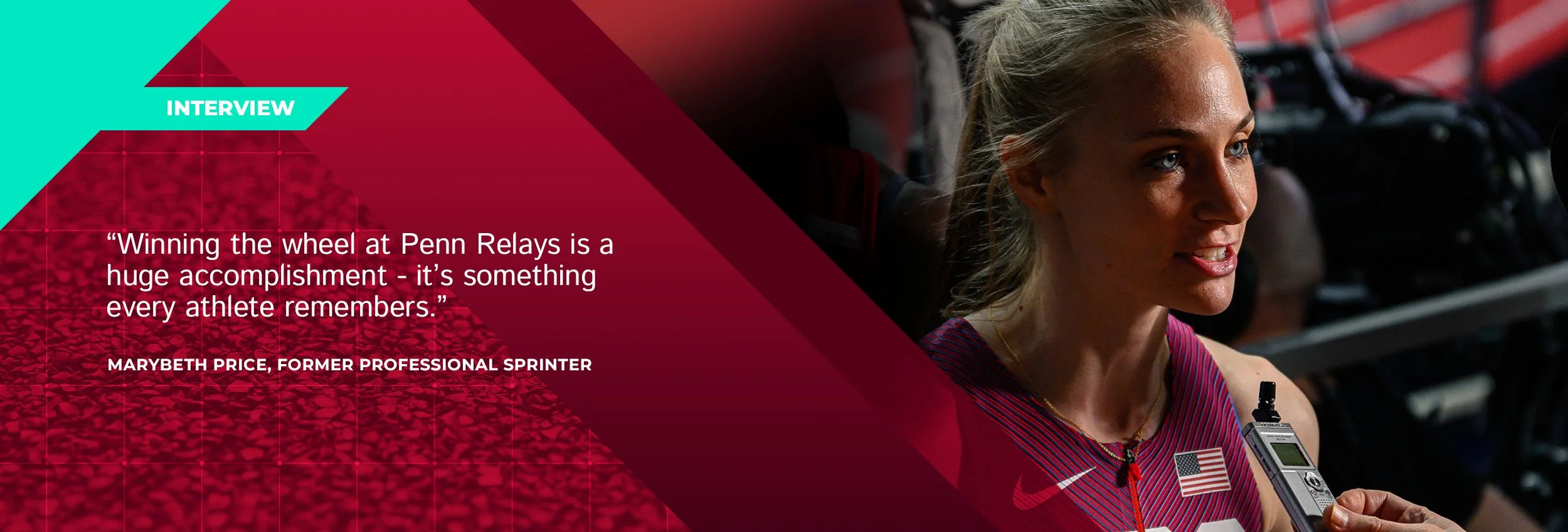
Former professional sprinter shares what separates rising talent from true elite performers.
As Penn Relays approaches, we sat down with former professional sprinter Marybeth Price to talk about what separates good athletes from great ones, how young track athletes make the leap to the elite level, and why Penn Relays remains one of the most defining stages in the sport.
When you look back, what early signs separate a “good” high school athlete from one with true elite potential?
For sprinters, a lot of it starts with what your body naturally gives you - fast twitch fibres, quick turnover, that explosive pop. I had that from a young age. That’s a gift not everyone has.
But honestly, the mental side is just as important, if not more. You can be physically talented, but if you don’t have that competitive edge, you won’t get to the next level. The athletes who make it are the ones who love the pressure. They enjoy the competition more than the training. They want to line up against the best.
My coach, Tony Wells, used to run all kinds of testing in practice. I never tested well - ever. Then competition came, and I would beat everyone. He called it “the dog in me.” That competitive heart is what separates the good from the elite.
When did you first realise you had the potential to compete at the world class level?
In high school, I was ranked number one in the nation in the 60m and 100m, which was the first hint that I was on a different trajectory. Hearing coaches and competitors say, “You’re different,” was eye opening. But the real turning point came when I qualified for USATF Indoor Nationals and raced professionals while still in high school – and held my own. That was the moment I realised, I belong here.
I also learned early that talent alone wouldn’t carry me. At the elite level, everyone is talented. What separates people is the ability to show up every single day - even when you’re exhausted, injured, or doubting yourself. That mindset shift was huge for me.
“Penn Relays is one of those meets where you either grow up fast or you don’t. The pressure is real - the crowds, the history, the expectation.”
What were the biggest adjustments you had to make when transitioning from high school to elite competition?
One of the hardest changes was losing the team environment. In high school, you have a whole squad around you. At the elite level, it’s just you and your coach. You have to trust yourself more, trust your training more, and be comfortable standing alone in those big moments.
The lifestyle shift is just as big. Training, diet, recovery, film study – it becomes who you are, not just what you do. You live it every day, even off the track. That level of commitment is what separates the athletes who stay good from the ones who actually break through.
Penn Relays is such an iconic meet. What role does it play in athlete development?
Penn Relays is one of those meets where you either grow up fast or you don’t. The pressure is real - the crowds, the history, the expectation.
For sprinters especially, the rounds are ruthless. You can be number one in the world, but if you don’t perform that day, in that heat, you’re out. Penn teaches you how to turn your mind off and just execute.
I remember being a freshman at Oregon in 2014. Our coach pushed us hard to win the 4x100 because it was the best of the best going head to head. We had special uniforms, the whole thing. Winning the wheel at Penn Relays is a huge accomplishment - it’s something every athlete remembers.
Penn gives you exposure, pressure, and a taste of elite level competition long before you turn pro. It prepares you mentally and physically for what’s coming.
“A good surface keeps you fresh. It protects your joints, helps with recovery, and lets you train consistently - which is everything in sprinting.”
Are there athletes whose Penn Relays performances really stuck with you?
Absolutely.
Sydney McLaughlin is the first. She competed at Penn in high school and you could tell immediately she was going to be special. Her mental clarity and ability to stay grounded under pressure is unbelievable. Watching her career unfold has been inspiring.
Quincy Wilson is another one - young, insanely talented, and you can just see where his career is heading based on how he handled those big Penn moments.
How important is the right track surface for long term athlete development?
It’s huge. You have to stay healthy to perform at the next level. When you’re transitioning from high school to college, you need to hit your peak - you can’t be dealing with lingering injuries.
I struggled with injuries at Oregon because we trained on an older, harder track. I was out for two years. When I transferred to Colorado State, the newer track made a massive difference. I stayed healthy and performed at a much higher level.
A good surface keeps you fresh. It protects your joints, helps with recovery, and lets you train consistently - which is everything in sprinting.
What advice would you give an athlete competing at Penn Relays for the first time?
Soak it in. Be present. Believe in yourself.
It’s easy to get overwhelmed by the size of the meet – the crowds, the noise, the history. But if you stay focused and confident, you’ll do well. Trust your training, trust your instincts, and have fun. Moments like Penn Relays don’t come around often.