
Rekortan has the most World Athletics certified tracks. But what does that endorsement mean?
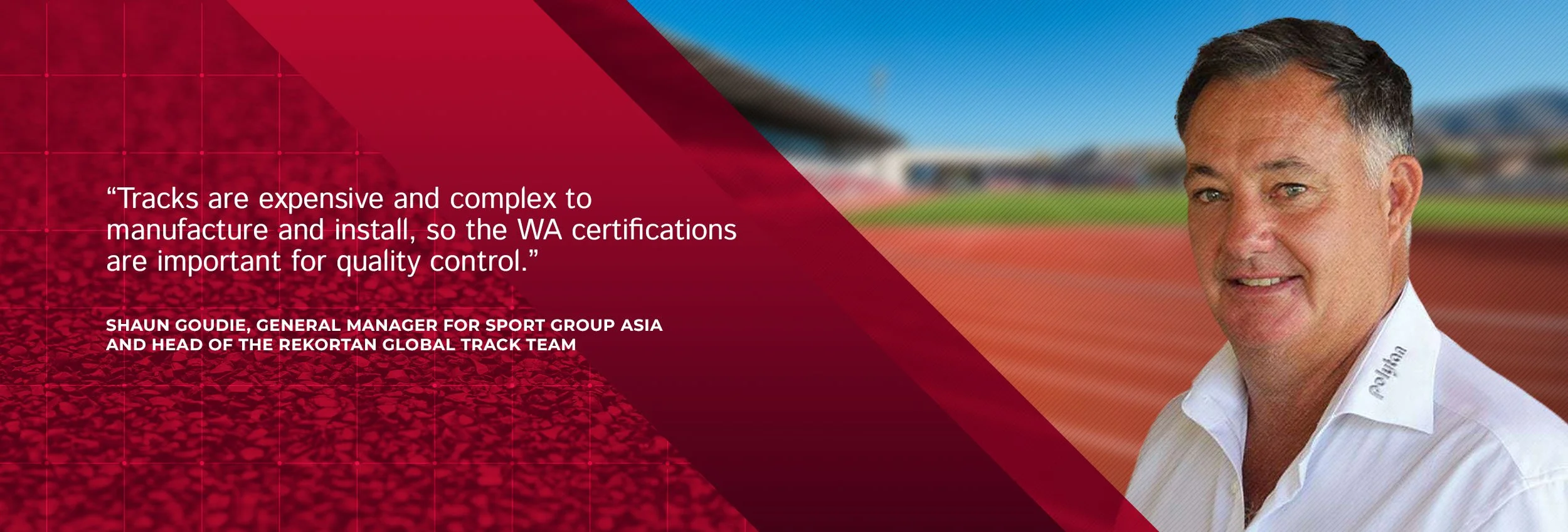
Shaun Goudie, our Global Track Team Lead explains all…
Shaun Goudie, as General Manager for Sport Group Asia and Head of the Rekortan Global Track Team, heads up the biggest track installation network in the world. We caught up with Shaun to discuss his concerns about track quality and how the World Athletics certifications are helping.
You must be one of the most experienced track builders in the world?
Yes, I would think so. Over the last 20 years I have installed 200 tracks or more across Asia and around the world.
Bophal, India
The World Athletics (WA) track certifications are very important, can you explain how they work?
Tracks are expensive and complex to manufacture and install, so the WA certifications are important for quality control. Class 1 is required for events such as the Olympics, World Champs and important regional or national competitions.
Class 2 is more common for tracks that wish to host regional or national events, plus many cities or sports funding organizations require Class 2 certification as proof of quality.
How does the qualification process work?
First, the track must be a WA approved product. Once installed, Class 1 requires an in-situ field test from an approved laboratory. The installed track must pass the various standards such as shock absorption, friction, thickness, etc., and have precise dimensions, and markings.
For Class 2 the facility’s dimensions (lane widths, curves, markings, field event sites) must be confirmed. However, WA does not differentiate between Class 1 & Class 2, and both are required to meet the WA Technical requirements laid down in the Track and Field Facilities manual.
Bophal, India
“Tracks are a major investment, and owners deserve a long-term asset and athletes need safe, high-quality surfaces.”
Tangerang, Indonesia
There were significant changes made to the certifications program in 2019. Can you fill us in?
In 2019 World Athletics introduced a maximum 5-year rule. At the end of five years, there is an option to re-test and extend it for three further years and then another three years, which gives you a 12-year total certification period.
The re-testing for Class 1 requires a full in-situ test like it initially did, while Class 2 re-testing is a visual test of the track to ensure that the track is in good condition.
What are World Athletics hoping to achieve with these stricter criteria?
They want stronger quality control. Established manufacturers (some like Rekortan with +40 years’ experience) have long delivered reliable tracks, but there has been an increase in newer manufacturers. They might pass the lab tests, but I am seeing more and more tracks fail in real-world conditions. A track must be very good to withstand blazing sun, high humidity, rain and snow for years and years.
It is very good that the sport’s leadership is addressing this quality issue.
Bophal, India
If a track has a product certificate, why is it not always good on the ground?
There’s a perception that tracks are simple to install. Quality installation is very difficult and requires a deep knowledge of materials, substrates and weather impacts. If facilities want even the first extension, they need skilled crews with the right expertise.
Where do installation issues tend to happen?
Problems often stem from inexperienced crews. Tracks use two-component polyurethanes; if they’re mixed poorly or rushed, the system doesn’t fully cure, producing weak surfaces prone to tearing from the spikes and delamination.
Subbase mistakes, like laying cold asphalt, poor leveling, or bad compaction, also lead to cracking and failures. Too often, shortcuts are taken to save time and money.
How does Sport Group avoid these issues?
Unlike many manufacturers who only sell drums of products to third-party installers, Sport Group companies Rekortan and Polytan manage both production and installation.
By controlling the entire process, from material manufacturing to installation, we ensure every track consistently meets WA standards. In contrast, manufacturers without installation capacity are essentially chemical suppliers, not true track companies
“The bitterness of poor quality remains long after the sweetness of a low price is forgotten.”
Is product efficacy an issue in the industry?
Yes, I am very worried about this – it is bad for the industry and bad for the sport.
In some regions, low-grade material from unsolicited supply chains or even off-the-shelf chemicals are being used. High-quality chemistry is essential to withstand years of UV, water, and heat. Inferior materials break down quickly, and incompatible mixes cause premature failures.
This is the number one reason we are asked to repair failed tracks, and the problem is growing.
Why is the number of low-quality tracks increasing?
As the newer, inexperienced companies compete for sales, prices are driven down, and with lower prices come cheaper materials and rushed, unskilled installation.
If the price seems too good to be true, it usually is.
The World Athletics certified track list has dropped by about 50% in recent years — what does this tell us?
It shows that many tracks can’t qualify for a five-year extension. In fact, from what I see inferior materials and poor construction mean they barely last that long.
Are stricter certification requirements a good thing?
Absolutely.
Tracks are a major investment, and owners deserve a long-term asset and athletes need safe, high-quality surfaces. The tougher standards filter out weaker products. A track that lasts 8+ years and can then be resurfaced delivers the best ROI for owners, athletes, and the environment.
What’s your advice to anyone seeking a new track?
Have a look at the ‘extensions’ column on the World Athletics certified facilities report. This will give you a good guide as to who has a proven integrated supply chain, chemicals that last and installation success.
Remember the proverb, ‘the bitterness of poor quality remains long after the sweetness of a low price is forgotten’.